Discover the true history of cassava in Africa, what Africans ate before its arrival, and the rich farming traditions often ignored by history.
Did Europeans Bring Cassava to Africa? The Real History Behind Africa’s Most Famous Crop
For generations, cassava has been one of Africa’s most important food crops. It feeds millions of families every day and is processed into popular foods such as garri, fufu, lafun, tapioca, and abacha. Because it is so common, many people naturally believe cassava has always been native to Africa.
Recently, a claim circulating online has sparked debate. It says the Portuguese introduced cassava to Africa after their voyages to the Americas. Some people reject this idea completely, arguing that Europeans are once again trying to take credit for African history.
So what is the truth?
At African Reality, we believe history should be guided by evidence, not emotion or colonial myths. Let’s examine what historians, archaeologists, and scientists know.
Africa Was Feeding Itself Long Before European Contact
One of the biggest misconceptions is that Africa depended on Europe for agriculture.
Nothing could be further from the truth.
Long before Portuguese ships reached West Africa in the fifteenth century, Africans had already built thriving farming communities and powerful kingdoms supported by agriculture.
Across West Africa, farmers cultivated:
- Yam
- Sorghum
- Pearl millet
- Fonio
- African rice (Oryza glaberrima)
- Cowpeas (black-eyed beans)
- Bambara groundnut
- Sesame (beniseed)
- Oil palm
- Okra
- Watermelon
- Various leafy vegetables and fruits
These crops supported great civilizations including the Kingdom of Benin, the Mali Empire, the Songhai Empire, and many others.
If you have not already, read our feature on The Benin Kingdom Before Colonisation, where we explore how one of Africa’s greatest kingdoms developed sophisticated cities, trade, and agriculture long before European rule.
Africa did not need Europe to learn how to farm.
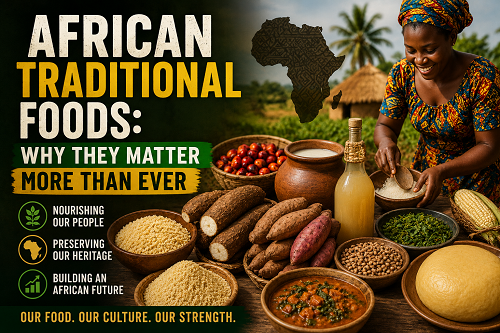
If you’re interested in how Africa’s indigenous crops and traditional foods continue to shape the continent’s future, read African Traditional Foods: Why They Matter More Than Ever, where we explore why Africans should invest in and preserve their own agricultural heritage.
So Where Did Cassava Come From?
According to modern botanical research, cassava was first domesticated thousands of years ago in what is now Brazil and neighbouring parts of South America.
Scientists reached this conclusion by studying:
- Archaeological discoveries
- Plant genetics
- Wild cassava species still growing naturally in South America
Current scientific evidence shows that cassava’s closest wild ancestor is found in Brazil, not Africa.
There is currently no accepted archaeological evidence showing cassava existed in Africa before the sixteenth century.
Did the Portuguese Bring Cassava to Africa?
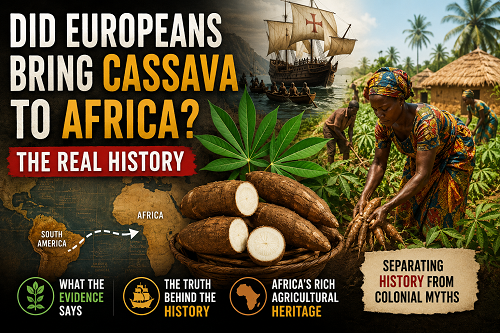
Most historians believe the answer is yes.
After Portuguese explorers established trade routes between South America and West Africa during the sixteenth century, cassava was introduced into several African coastal regions.
However, this does not mean Europeans “fed Africa.”
Instead, African farmers quickly recognised cassava’s advantages.
Unlike many crops, cassava:
- grows well in poor soil
- survives long periods without rain
- produces high yields
- remains underground until needed
- provides food during famine
African communities adopted cassava because it was useful—not because they lacked food before its arrival.
Over time, Africans transformed cassava into uniquely African foods and traditions that remain central to many cultures today.
Europe and Africa Were Trading Long Before Colonisation
Another common misconception is that Europeans suddenly “discovered” Africa.
In reality, Africa had long been connected to international trade.
Before Portuguese ships sailed around West Africa, African goods already reached Europe through North African and Mediterranean trade routes.
Among the products traded were:
- Gold from present-day Ghana and Mali
- Ivory
- Leather
- Salt
- Pepper
- Textiles
- Gum arabic
- Beeswax
After the Portuguese reached the West African coast, direct maritime trade expanded.
Countries such as present-day Ghana, Nigeria, Benin, Senegal, Angola, and the Kingdom of Kongo became important trading partners with Portugal and other European nations.
Trade was not one-sided. African kingdoms negotiated, taxed, and controlled much of this commerce according to their own political systems.
Crops Did Not Move in Only One Direction
History often focuses on crops that arrived in Africa while ignoring those Africa gave to the world.
African crops that spread globally include:
- African rice
- Okra
- Black-eyed peas
- Sesame (beniseed)
- Watermelon
- Oil palm
Likewise, several crops introduced from the Americas became successful in Africa because African farmers adapted them to local conditions.
These include:
- Cassava
- Maize
- Sweet potato
- Groundnut (peanut)
- Chilli peppers
This global exchange reshaped agriculture on every continent.
Separating History from Colonial Narratives
Colonial writers often portrayed Africa as a continent without civilisation until Europeans arrived.
That picture is false.
At the same time, rejecting every historical conclusion simply because Europeans recorded part of it can also lead us away from the truth.
The real story is more powerful.
Africa already possessed advanced farming systems, thriving kingdoms, skilled traders, and sophisticated knowledge long before European expansion.
When cassava arrived, African farmers did what they have always done throughout history—they evaluated a new crop, improved it, and made it their own.
Today, cassava may have originated in South America, but its cultivation, processing, and cultural importance in Africa are undeniably African.
Cassava is only one part of Africa’s rich agricultural story. Discover why preserving traditional crops and supporting local food industries matters in our feature African Traditional Foods: Why They Matter More Than Ever.
The African Reality
History should never be used to diminish Africa’s achievements.
Neither should it ignore credible scientific evidence.
Africa did not become an agricultural civilisation because Europeans arrived.
Africa already was one.
Understanding this difference allows us to celebrate Africa’s true achievements while remaining faithful to historical evidence.
If you enjoyed this article, you may also like:
- The Benin Kingdom Before Colonisation: A Powerful African Civilization That Thrived Before European Rule
- The Real Life in Africa the Media Rarely Talks About
Together, these stories reveal a richer and more accurate picture of Africa’s past—one based on evidence rather than stereotypes.
Sources
- Food and Agriculture Organization (FAO). The Cassava Transformation in Africa.
- Kew Science. Manihot esculenta (Cassava) Botanical Profile.
- Nassar, N.M.A. Cassava: Origin and Domestication.
- Fuller, D.Q., et al. Research on African crop domestication.
- Carney, Judith A. Black Rice: The African Origins of Rice Cultivation in the Americas.